

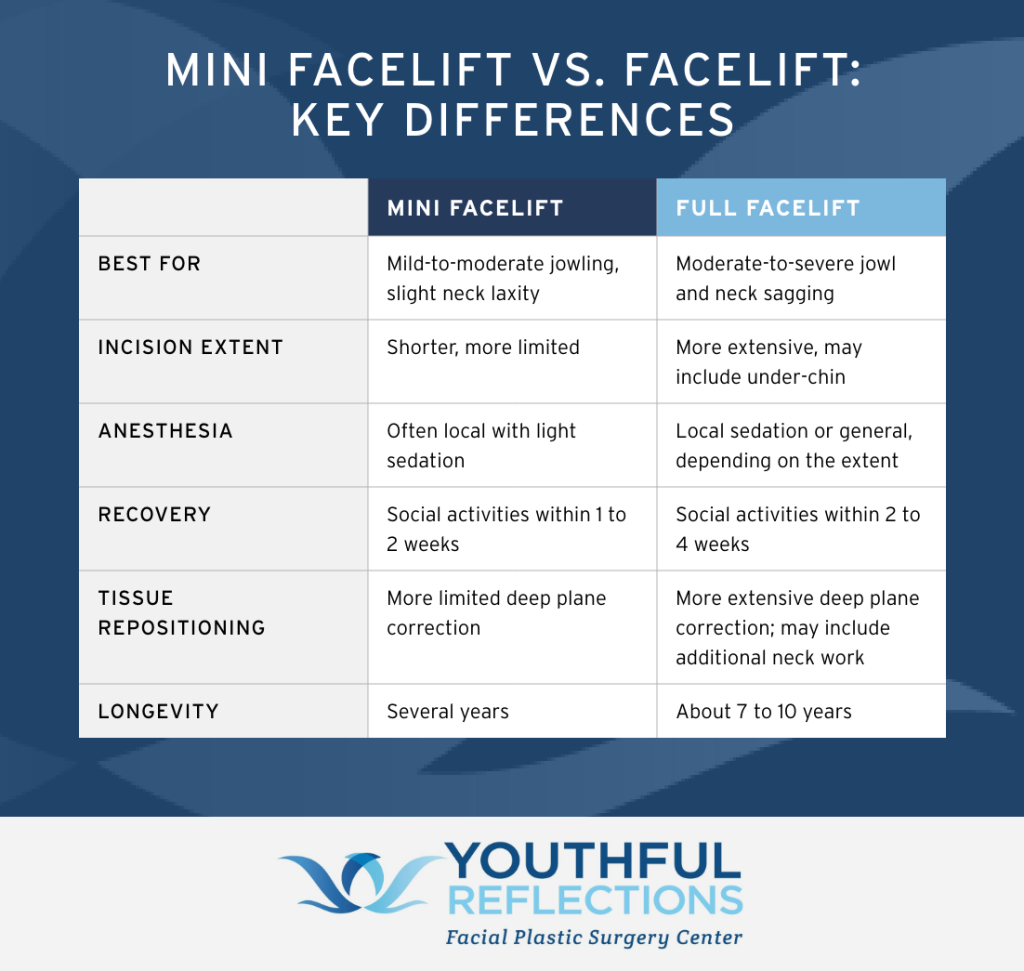
A mini facelift and a full facelift both lift and tighten the face, but they solve different problems. A mini facelift corrects early jowling and mild neck laxity through a shorter incision and a more limited lift. A full facelift, such as my signature Reflection Lift, addresses moderate-to-severe sagging in the jowls and neck, often accompanied by muscle tightening beneath the skin.
Below, I break down how each facelifting procedure works, what sets a deep plane technique apart from a more superficial approach, and how to know which lift matches your face and your goals.


What Is a Mini Facelift?
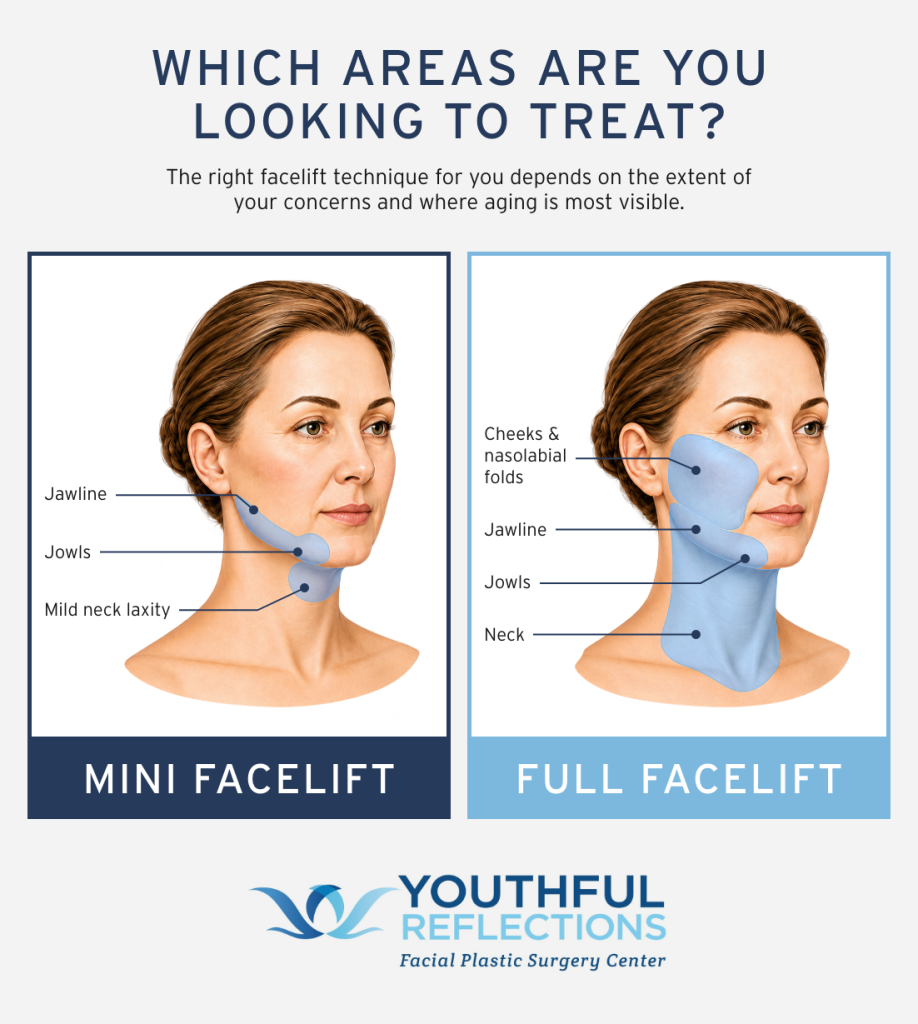
A mini facelift is a conservative procedure designed for patients in the early stages of facial aging, typically those with mild-to-moderate jowling and slight laxity in the upper neck. It generally offers a shorter incision and a more targeted correction than a full facelift, making it a good option for younger patients or patients returning for a touch-up after a previous procedure.
Because the changes being addressed are smaller in scope, a mini facelift can often be performed “awake,” using local anesthesia with light sedation instead of general anesthesia. I prefer this approach whenever possible, as it supports a smoother, shorter, and more comfortable recovery. At Youthful Reflections Facial Plastic Surgery Center, I use a deep plane technique even for my mini facelifts. This approach repositions the underlying muscle and connective tissue rather than just pulling the skin. The result is a refreshed, natural-looking jawline without the tightness associated with older, skin-only approaches.
What Is a Full Facelift?
A full facelift addresses moderate-to-severe sagging in the jowls and neck, including muscle laxity that a mini facelift isn’t designed to correct. My approach, the Reflection Lift, isn’t one fixed procedure but is tailored across three levels of correction, from conservative jowl and neck tightening to more extensive work that includes tightening the neck muscle at the midline.
Like the mini facelift, every level of my Reflection Lift uses a deep plane technique, creating results that look natural and well-balanced, whether the correction is subtle or comprehensive.
Deep Plane Facelift vs. Regular Facelift
A “regular” facelift can refer to several techniques, including approaches that tighten the skin and underlying SMAS layer. A deep plane facelift works beneath the SMAS, releasing deeper attachments so the facial tissues can be repositioned together.
That’s the real distinction to look for when comparing facelift techniques: which layer is actually being lifted, not how the procedure is labeled or marketed.
Facelift Recovery and Results
Recovery follows a similar path whether you’ve had a mini or full facelift. Most patients see noticeable swelling and bruising resolve within 10 to 14 days of their surgery, with a return to work and non-strenuous activities around the same time.
Full social readiness typically follows within 2 to 4 weeks, although soft tissue swelling continues to settle for another month or 2 after that. Your final results will take shape gradually over 9 to 12 months as the deeper tissues heal and settle into their new position.
For tips on extending your results once you’ve healed, see our guide on making a facelift last longer.
Is a Deep Plane Facelift Worth It?
For most patients, yes—not because it’s a luxury upgrade, but because it’s simply the more effective way to perform a facelift when structural support has weakened. That’s why I don’t treat it as an optional add-on. Instead, a deep plane facelift is the standard basis for my Reflection Lift at every level, with only the amount of correction changing from patient to patient.
How Do I Know Which Lift Is Right for Me?
The most reliable way to know which facelift technique is right for you is a hands-on evaluation of your facial anatomy, since two patients with similar wrinkles can be dealing with very different concerns underneath the surface.
It’s also worth noting that a deep plane facelift isn’t tied to size: Both a mini facelift and a full facelift can be deep plane, so the real question isn’t which one sounds more advanced, but how much correction your face actually needs.
Take the Next Step
A mini facelift and a full facelift at Youthful Reflections aren’t two different procedures: They’re different levels of the same Reflection Lift system, from a conservative Level 1 lift to a more extensive correction at Level 2 or 3.
To get a sense of what that investment looks like for your specific needs, see our guide to facelift costs in the Nashville area. When you’re ready to explore your options, please request a consultation or call my office at (615) 942-8016 to get started.

Leave a Reply